
Understanding Operational Bottlenecks and Their Impact on Business Performance

Every organization seeks greater efficiency, improved productivity, and sustainable growth. However, many businesses struggle with hidden constraints that slow operations, increase costs, and reduce overall performance. These constraints, commonly known as operational bottlenecks, can significantly affect a company’s ability to meet customer expectations, deliver projects on time, and maximize profitability.
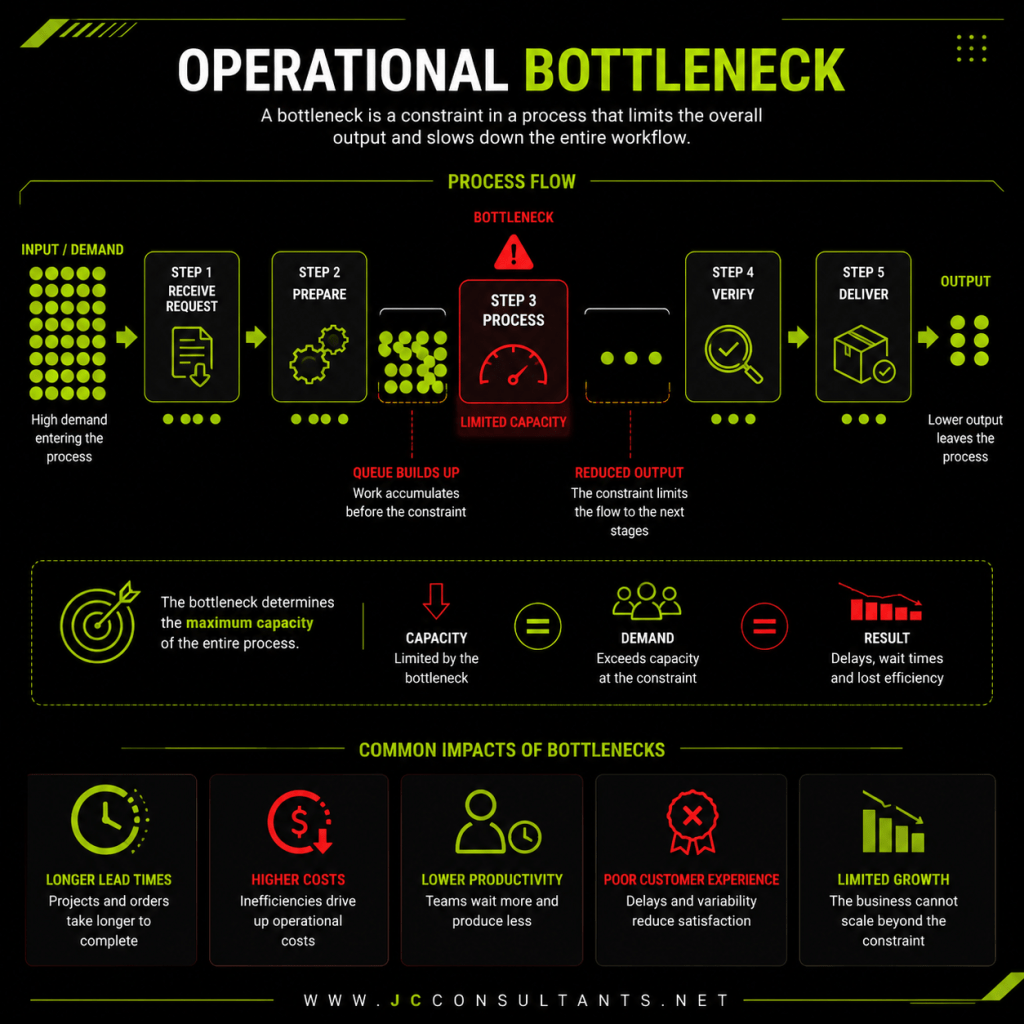
A bottleneck occurs when a specific process, resource, department, or activity limits the flow of work throughout an organization. Similar to how the narrow neck of a bottle restricts the flow of liquid, bottlenecks restrict the flow of operations and create delays that impact the entire system.
Identifying and addressing bottlenecks is one of the most effective ways to improve operational efficiency without making substantial investments in new equipment, facilities, or personnel.
What Is an Operational Bottleneck?
An operational bottleneck is any point within a process where demand exceeds capacity. As work accumulates at that point, delays begin to affect downstream activities, creating inefficiencies across the organization.
Common examples include:
- Slow approval processes
- Limited staffing resources
- Inefficient workflows
- Equipment downtime
- Poor communication between departments
- Inadequate inventory management
- Manual data entry procedures
- Lack of process standardization
While some bottlenecks are easy to identify, many remain hidden within daily operations and continue affecting performance for years.
Signs That Your Organization Has Bottlenecks
Businesses often experience symptoms before identifying the actual source of the problem.
Common warning signs include:
Missed Deadlines
Projects consistently fall behind schedule despite significant effort from employees.
Growing Backlogs
Tasks accumulate faster than they can be completed.
Increased Overtime
Teams regularly work extra hours to meet deadlines.
Customer Complaints
Delivery delays and service issues become more frequent.
Resource Underutilization
Some departments remain idle while others are overwhelmed.
Reduced Profitability
Operating costs increase while productivity remains stagnant.
If your organization experiences several of these symptoms, operational bottlenecks may be limiting performance.
How to Identify Bottlenecks in Business Processes
1. Map Your Processes
The first step is understanding how work flows through the organization.
Process mapping helps visualize:
- Inputs
- Activities
- Decision points
- Outputs
- Responsible personnel
By documenting each step, organizations can identify areas where delays or inefficiencies occur.
Flowcharts, process maps, and workflow diagrams are valuable tools for this analysis.
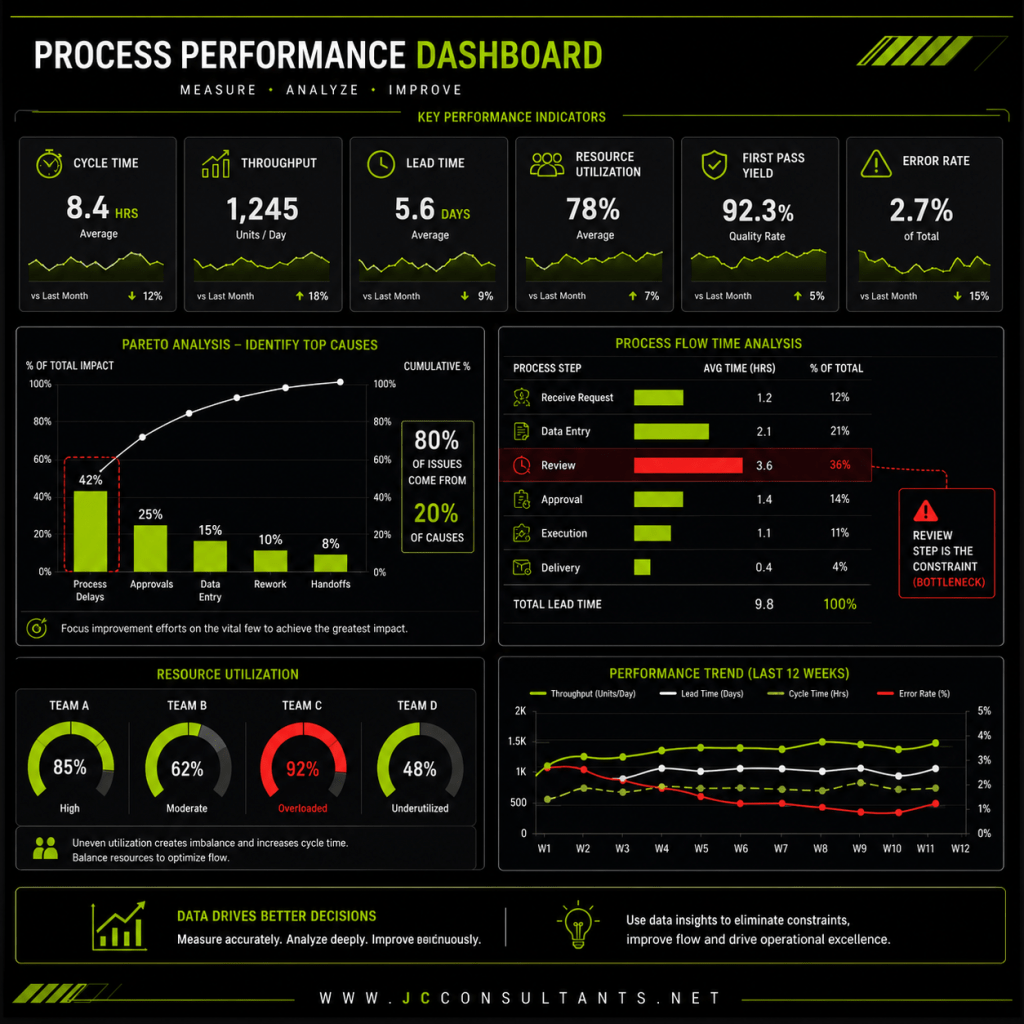
2. Measure Process Performance
Data is essential for identifying constraints.
Key metrics include:
- Cycle time
- Throughput
- Lead time
- Waiting time
- Resource utilization
- Error rates
Collecting performance data provides objective evidence of where operational issues exist.
3. Observe Workflow Directly
Managers and consultants often discover bottlenecks simply by observing operations.
Direct observation reveals:
- Work queues
- Unnecessary approvals
- Communication gaps
- Manual activities
- Redundant tasks
Employees frequently develop workarounds that hide inefficiencies from management reports.
4. Analyze Work Queues
One of the clearest indicators of a bottleneck is work accumulation.
If tasks consistently pile up at a specific stage, that stage likely lacks sufficient capacity.
Organizations should monitor:
- Pending approvals
- Production queues
- Service requests
- Customer inquiries
- Documentation reviews
Large queues often point directly to the source of the constraint.
5. Conduct Employee Interviews
Employees working closest to processes often understand operational challenges better than leadership teams.
Ask questions such as:
- What tasks cause delays?
- Which approvals take the longest?
- Where do errors occur most frequently?
- What would improve efficiency?
Their insights can reveal hidden obstacles that data alone may not identify.
Using Pareto Analysis to Identify Bottlenecks
Pareto Analysis is a powerful decision-making tool frequently used in quality management and operational improvement.
The principle suggests that approximately 80% of problems often result from 20% of causes.
Organizations can:
- Categorize operational issues
- Measure their frequency
- Rank their impact
- Prioritize corrective actions
By focusing on the most significant contributors to inefficiency, companies can achieve substantial improvements with limited resources.
Common Sources of Operational Bottlenecks
Staffing Constraints
Insufficient personnel or lack of specialized expertise can limit productivity.
Technology Limitations
Outdated software systems often create delays and manual work.
Inefficient Procedures
Complex workflows frequently contain unnecessary steps.
Communication Issues
Poor coordination between departments can slow decision-making.
Inventory Problems
Supply shortages disrupt production and service delivery.
Equipment Downtime
Maintenance issues reduce operational capacity.
Understanding the root cause is critical before implementing solutions.
Strategies for Eliminating Bottlenecks
Standardize Processes
Documented procedures improve consistency and reduce delays.
Automate Repetitive Tasks
Automation reduces manual effort and increases throughput.
Improve Resource Allocation
Ensure resources are distributed according to workload demands.
Reduce Unnecessary Approvals
Simplifying decision-making processes can significantly accelerate operations.
Invest in Training
Skilled employees often resolve issues more efficiently and reduce error rates.
Monitor Performance Continuously
Operational improvement should be an ongoing effort rather than a one-time project.
The Benefits of Bottleneck Analysis
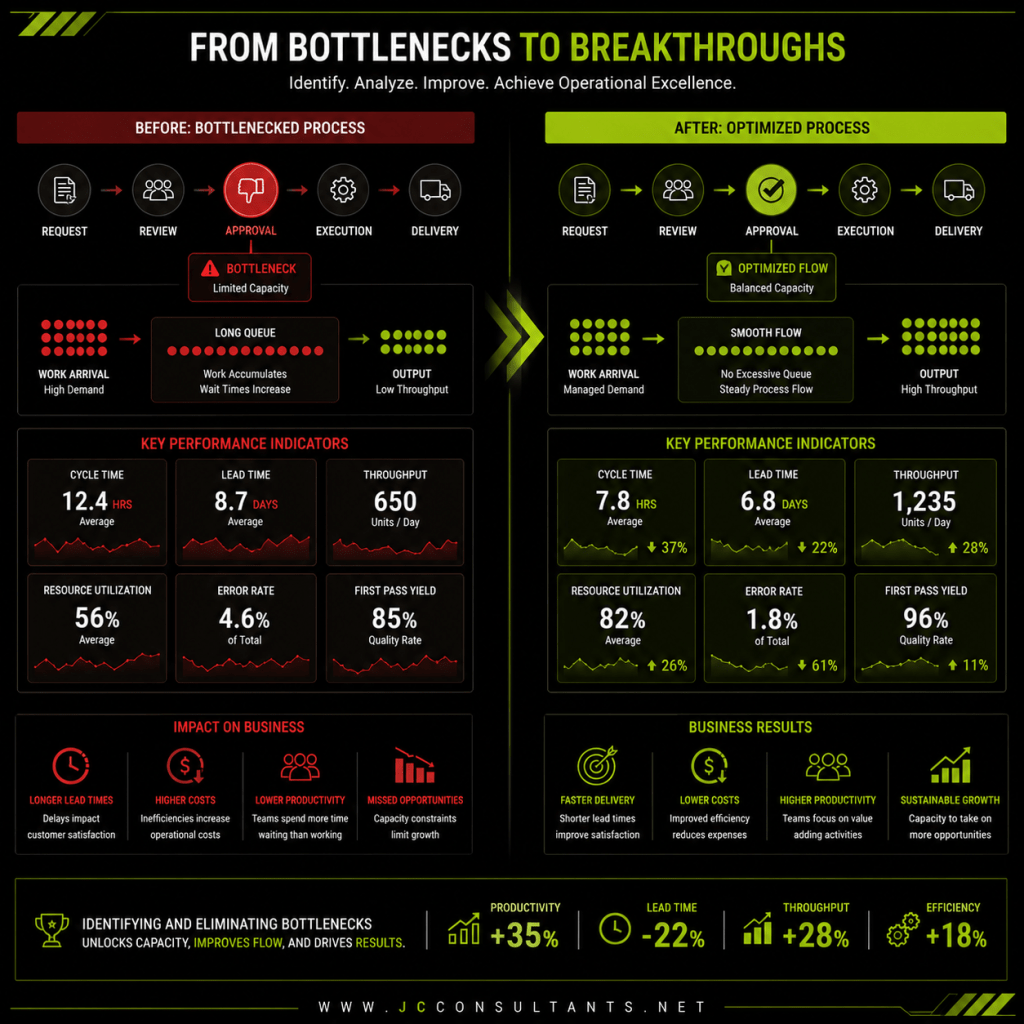
Organizations that identify and eliminate bottlenecks often achieve:
- Faster process completion
- Improved productivity
- Lower operating costs
- Better customer satisfaction
- Increased profitability
- Enhanced employee engagement
- Greater operational flexibility
Even small improvements can create significant long-term benefits.
Conclusion
Operational bottlenecks are among the most common obstacles to business growth and efficiency. By systematically analyzing workflows, collecting performance data, engaging employees, and applying continuous improvement principles, organizations can identify constraints and implement practical solutions that deliver measurable results.
At JC Consultants, we help organizations identify operational bottlenecks, optimize processes, improve efficiency, and support data-driven decision-making initiatives that contribute to sustainable business growth.
Let’s Build Better Solutions Together
Contact us to discuss your next project, research initiative, staffing need, or operational challenge.
 JC Consultants
Leave a comment